Taking your company vehicle abroad requires preparation and knowledge of different requirements. Our comprehensive guide covers everything you need for a successful international journey.
Three Keys to Success for Your Drive Abroad
Whether you’re traveling for work or taking a holiday with your company vehicle, preventing problems starts with proper preparation. Follow these three essential steps before going abroad, which we summarise as DRIVE: Documents, Relevant Information, and Vehicle Equipment.

Documents
Key documents you’ll need include:
- A VE103 vehicle-on-hire certificate for your company vehicle
- Your driving licence
- Proof of insurance
- Breakdown cover documentation
If you have a credit card-style UK driving licence, most countries currently don’t require an International Driving Licence. However, you must check with your employer or review your company car policy to confirm you have permission to take your vehicle out of the country.
Relevant Information
It’s crucial to research the rules of the road at your destination, including:
- Speed limits
- Emissions restrictions
- Local driving regulations
Many European cities have introduced emissions restrictions, so verify whether you need a permit before traveling. For example, driving in France’s major cities requires a Crit’Air sticker.
Vehicle Equipment
Ensure your car has everything needed for the journey. Some required items are country-specific, while others are almost universal. Create a checklist to ensure you’re fully prepared.
Before traveling, consider whether your vehicle needs servicing:
- Is your MOT due soon?
- Do your tyres need changing?
- Are there any maintenance issues to address?
Contact your Driver Services team to determine if a garage visit is necessary before your planned trip.
Safety Equipment: Standard Items for Your Journey
Regulations regarding mandatory safety equipment vary by country. For detailed guidance, visit the AA Touring Tips and the government’s Driving in the EU guide. 
Essential items include:
1. Beam Deflectors
In countries where you drive on the right, beam deflectors prevent your headlights from blinding oncoming drivers. Some modern vehicles feature automated headlight beam adjustment technology – check your vehicle handbook for details.
2. Warning Triangle
Most cars come with a warning triangle, but verify yours has one. Most countries require it, though Spain is transitioning to a flashing beacon placed on top of the car.
3. Reflective Vest
Carry enough for all passengers inside the car where they’re easily accessible. These ensure you’re visible when outside the vehicle during a breakdown.
4. First Aid Kit
This is compulsory in many European countries. While you may never need it, it could prove vital in an emergency.
5. Fire Extinguisher
Though only compulsory in a few countries, this valuable safety equipment should be within its expiry date to ensure reliable operation if needed.
Driver Questions
Do I need an international driving permit (IDP)?
You must carry your UK driving licence. An IDP isn’t required to drive in the EU, Switzerland, Norway, Iceland or Liechtenstein if you have a UK photocard driving licence.
However, you might need an IDP in some EU countries and Norway if you have:
- A paper driving licence
- A licence issued in Gibraltar, Guernsey, Jersey or the Isle of Man
Since 1st April 2024, IDPs are available exclusively from participating PayPoint stores. We recommend carrying an IDP in case you cross into a country that requires one. You may also need one when renting a car abroad.
To apply for an IDP:
- You must be 18 years or over
- You must have a valid UK driving licence
- An IDP cannot be issued to provisional licence holders
Do I need a UK/GB sticker?
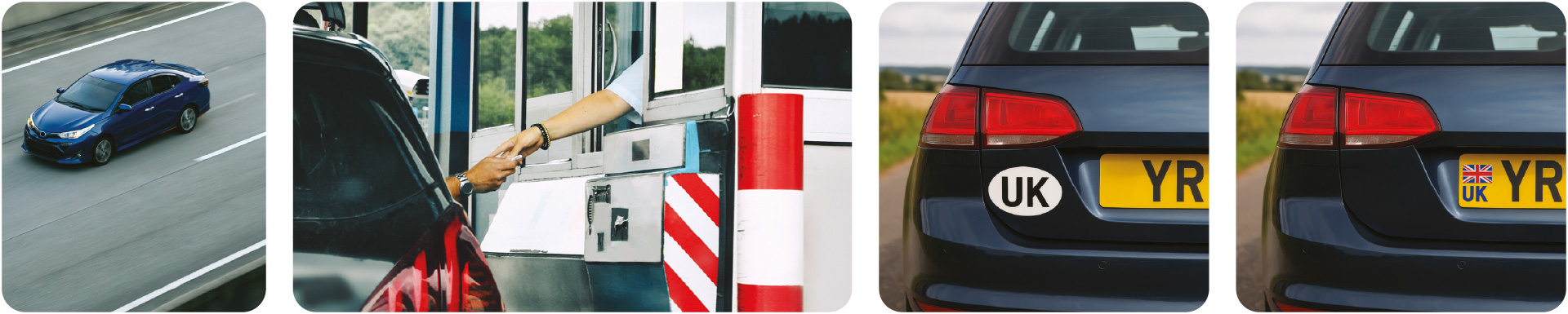
You must display the UK identifier when driving a UK-registered vehicle abroad.
If your number plate includes the UK identifier with the Union flag (Union Jack), you don’t need a UK sticker.
However, you will need to display a UK sticker clearly on the rear of your vehicle if your number plate has any of the following:
- A GB identifier with the Union flag
- A Euro symbol
- A national flag of England, Scotland or Wales
- Numbers and letters only
- No flag or identifier
In Spain, Cyprus or Malta, you must display a UK sticker regardless of what’s on your number plate. No UK sticker or identifier is required when driving in Ireland.
Do I need a green card
Since 2021, a Green Card (International Motor Insurance Card) isn’t required for European travel, but you will need one for travel beyond Europe.
Take a copy of your insurance documents with you. See the government’s Vehicle Insurance guide for further details.
What if I have an accident abroad?
If you’re involved in an accident:
- Take pictures of the scene
- Obtain information from all parties involved and witnesses
- Contact your insurance provider as soon as possible
Any legal proceedings against either the responsible driver or their insurance provider must be brought in the EU or EEA country where the incident occurred. You might need to make your claim in the local language.
Be aware that in some countries, there may be no compensation if the accident is caused by an uninsured driver or if the driver cannot be traced. See the government’s advice page for more information.
Driving an Electric Vehicle Abroad
With millions of EVs on Europe’s roads, taking a plug-in vehicle abroad is no longer uncharted territory. However, planning remains essential.
For expert advice on taking your EV abroad, email your dedicated team.
1. Plan Your Stops
Before departure, identify proposed charging stops along your route. Having a plan reduces distraction while driving, minimizes stress, and allows you to map alternative sites in case of problems.
2. Download Apps in Advance
Choose an app that provides a comprehensive overview of European charging networks. Popular options include Chargemap, which also offers a multi-network payment card.
3. Stick Between 20% and 80% of Charge
Start your journey with a 100% charge and a pre-conditioned vehicle. While you might be tempted to recharge to 100% during your journey to maximize range, the time taken to charge from 80% to 100% is significantly longer. Your overall journey time will be reduced if you stop more frequently and charge to 80%.
Common Sense Precautions
Drive Defensively
Legal and cultural differences mean drivers and other road users may behave differently than in the UK. Be aware of risks and don’t assume drivers will be courteous or careful. Always maintain plenty of space between your vehicle and others.
Be Speed Aware
Speed limits vary by country, so know the limits and adhere to them to avoid substantial penalties. The use of radar detectors is illegal in some countries, including France.
Crime Prevention
A change of scenery doesn’t mean forgetting basic precautions:
- Never leave valuables visible
- Park in safe, well-lit areas when possible
- Don’t leave important documents, such as passports, in the car
Mobile Phones
Research shows that using a hand-held mobile phone increases crash risk. Even hands-free phones can seriously distract drivers. On unfamiliar roads, avoid all devices until safely parked.

Travel Checklist
Before traveling abroad with your company vehicle, ensure you:
- Obtain permission from your employer to take your vehicle abroad
- Have your photocard driving licence and International Driving Permit (if required)
- Contact your driver services team to arrange your VE103 certificate and European breakdown cover (allow plenty of time for this)
- Ensure your UK identifier (sticker or number plate) is properly displayed
- Apply for and obtain any required emissions stickers (e.g., Crit’air sticker for France)
- Apply for and obtain road toll passes to avoid manual booth payments (e.g., Ulys e-toll badge for France, Spain, Portugal, and Italy)
- Confirm your insurance covers international travel
- Research driving laws at your destination – see the full list here
- Apply or activate beam deflectors before driving on European roads
For more information or assistance with planning your international journey, contact our team:
Email: info@ifmfleet.co.uk
Phone: 01536 536 590