Proper maintenance of your company vehicle isn’t just about keeping it looking good – it’s essential for safety, reliability, and preserving its value. This comprehensive guide covers everything you need to know about maintaining your company vehicle to the highest standards.

Why Vehicle Maintenance Matters
Regular maintenance ensures your vehicle remains safe, reliable, and performs efficiently. It also helps:
- Maintain the vehicle’s value
- Reduce the risk of breakdowns
- Ensure safety for you and other road users
- Comply with your company vehicle policy
- Minimise environmental impact

Your Maintenance Responsibilities
As a company vehicle driver, you’re responsible for:
- Conducting regular vehicle checks
- Reporting any faults promptly
- Ensuring the vehicle is serviced according to schedule
- Keeping the vehicle clean inside and out
- Maintaining appropriate fluid levels
You can’t always prevent a vehicle breakdown, but there are things you can do to lessen the chances of it happening, and ensure your vehicle is safe and legal on the road.

We recommend performing these checks at least once a week and before any long journey:
1. Coolant level
Coolant is a mixture of water and antifreeze and can prevent your engine from overheating or stop the water in the system from freezing in cold weather. Make sure the engine is cool before opening the coolant cap. EVs also use coolant to prevent the battery from overheating. Check your manufacturer’s recommendations on topping up.
2. Brake fluid level
If the brake fluid level is low, it might result in the braking system not working correctly. Check against the maximum and minimum lines on the side of the reservoir and top up if necessary. If it drops again soon after it could indicate a leak.
3. Screenwash level
An empty windscreen washer fluid tank can result in an MoT failure. Don’t be tempted to top up with water, unless it’s an emergency, as it won’t clear the windscreen as effectively and may freeze in the winter.
4. Tyres
To stay safe on the road you need to check the condition, tread depth (the legal minimum is 1.6mm) and tyre pressure (the correct pressure will be in your vehicle handbook or printed on the inside of the fuel tank flap or driver’s door). Low tyre pressures can increase fuel consumption or reduce electric range.
Reducing Risk
Petrol/diesel Vehicle Checks
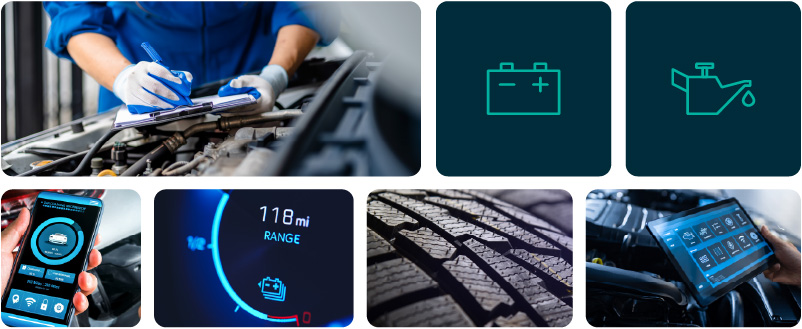
The battery – A flat or faulty battery is one of the most common causes of a vehicle breakdown. You need a good level of charge (about 75%), which can be checked at a garage. Starting the car once a week and running it for 15 minutes should keep the battery charged.
Engine oil – If this runs out you risk premature wear and the engine seizing up. Check the oil level when the engine is cold by removing the dipstick, checking the minimum and maximum gauge on it, wiping it, replacing it and then checking the mark again. If the level is below about two-thirds it’s a good idea to top up.
EV Specifics
Range/Preconditioning – Check available range before you set off; ideally the night before a long journey so you have time to top up or plan where to charge en- route. Set the cabin to the ideal temperature or demist the windscreen and windows while the car is plugged in and charging.
Battery Health – Keep the charge between 20% and 80%. EVs have 2 x batteries; the main battery and the auxiliary battery (which is like the one in a petrol/diesel). Be careful not to wear down the auxiliary battery by having items on when the vehicle is switched off.
Routine Servicing – It is just as important to ensure your electric vehicle is routinely serviced as any other vehicle. This ensures smooth motoring, it protects warranties and keeps you safe and compliant.
Tyres – Ensure your electric vehicle has the correct tyres fitted, which are specific to EVs. These improve range and longevity. Also, put your regenerative braking on its maximum so that it reduces the wear and tear of the brakes.
Maintaining Your Company Vehicle
What Do Dashboard Warning Lights Mean?
Warning lights are colour coded:
Red – There is a serious issue that needs immediate attention and you should stop the vehicle as soon as it’s safe to do so and call for assistance. This could be a warning about the battery, oil pressure or the brake system, for example.
Amber/Yellow – Indicates that action is required, but it’s not as serious as a red warning light. You should monitor the issue and address it as soon as possible. Examples include: low fuel, a change in your tyre pressure or a blocked diesel particulate filter (DPF).
Green/Blue – For information only. This usually shows when something is activated such as full beam lights or electric vehicle mode.

Penalties for driving an ‘unsafe vehicle
As a driver, you are responsible for the vehicle you are driving, and could be liable for:
- £2,500 fine
- Driving ban
- Three penalty points
Servicing your company vehicle
When?
How often your vehicle needs servicing may vary depending on the make and model, and your driving style. Generally, modern vehicles will advise you on the dashboard when a service is due, however many manufacturers recommend a service once a year or every 10,000 miles, whichever comes first.
Electric and hybrid vehicles still require regular servicing even though they have fewer moving parts. You can check the recommended service schedule in your vehicle handbook.
Why?
A vehicle service includes crucial safety checks to make sure everything is working correctly. They also help to detect minor issues early on before they develop into more serious and costly repairs, which may result in your vehicle being off the road for longer. Important – Failure to keep your vehicle serviced in accordance with manufacturers strict schedule intervals will invalidate the warranty. This may result rechargeable vehicle repairs as a result of missed or late services.
How? You can book a service by:
Phone: 01536 536 590
Email: info@ifmfleet.co.uk